From Ancient Forest to Rooftop: The Journey of a Cedar Shake
A cedar shake looks simple enough: a tapered piece of wood a couple of feet long. But each one has traveled a remarkable path before reaching a roof. That path often starts in a forest that was growing long before the house it protects was even imagined.
Where Western Red Cedar Grows
Western red cedar is native to the Pacific Northwest. Its range stretches along the coast from southeastern Alaska through British Columbia, Washington and Oregon into northern California. Inland populations grow in the mountains of Idaho, Montana and southeastern British Columbia. The tree thrives in cool, wet, shady forests where rain is frequent and summers are mild.
These trees are giants. Mature western red cedars commonly grow well over 150 feet tall, and the largest trunks can be more than ten feet across. They are also among the longest-lived trees in the region. Individual cedars can live for more than a thousand years, so some of the oldest standing trees were already ancient when the first European explorers sailed along the Pacific coast.
Why Slow Growth Matters
In dense, shaded forests, cedar grows slowly. Each year adds a thin growth ring, and slow growth packs those rings tightly together. Tight grain is one of the qualities that makes cedar so valuable for roofing. It produces wood that is stronger, splits more cleanly and holds up better to weather than fast-grown timber.
A Tree That Refuses to Rot
One fascinating part of cedar’s story is where much of the shake material has historically come from. Cedar heartwood is so resistant to decay that fallen logs, or logs left behind after earlier logging, can lie on the damp forest floor for decades and still contain sound, usable wood. For generations, a significant share of shake production in the Pacific Northwest has relied on salvaging this material. Wood that might otherwise go to waste becomes a long-lasting roof.
Blocks, Bolts and the Mill
At the mill, a log is cut into short sections matching the length of the finished product. Shakes are commonly 18 or 24 inches long. These sections, often called blocks or bolts, are then split or sawn depending on the type of shake being made.
Here grain becomes important again. Imagine looking at the end of a log and seeing its rings:
- Edge grain (also called vertical grain): the piece is cut so the rings run roughly perpendicular to its face.
- Flat grain: the rings run more or less parallel to the face.
Edge-grain wood swells and shrinks less as it gets wet and dries out, so it’s far less likely to cup, curl or split on a roof. The best shakes and shingles are made almost entirely from edge-grain heartwood.
Someone researching cedar roofing near me Northbrook might not expect grain orientation to matter much. Yet it’s one of the biggest factors in how a roof performs over the decades.
The Label on the Bundle
Cedar shakes and shingles are sorted by grade before they leave the mill. In the United States and Canada, much of this grading follows standards maintained by the Cedar Shake and Shingle Bureau, an industry organization whose roots go back to 1915. The top shingle grade, Number 1 Blue Label, must be 100 percent heartwood, 100 percent clear of knots and defects, and 100 percent edge grain. Lower grades allow some flat grain, sapwood or knots. Those may be fine for walls, outbuildings or other uses where performance demands are lower.
Each bundle typically carries a label identifying the grade and the mill, so the material can be traced back to where it was produced.
The Long Trip East
From the Pacific Northwest, finished bundles travel by truck and rail across the continent. A shake that ends up on a home in northern Illinois may have journeyed roughly two thousand miles from the forest where its tree grew. Some products are pressure-treated along the way for better fire resistance or protection against decay.
The Final Chapter
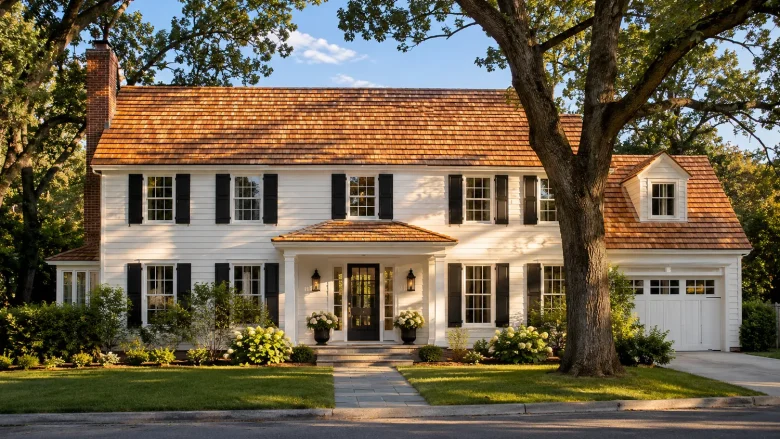
Once installed, a cedar shake begins the last stage of its journey. In its first year, it glows with warm reddish and amber tones. Over the following seasons, sunlight and rain gradually turn it a soft silvery gray. Many homeowners consider this natural weathering one of cedar’s greatest charms.
Next time you see a cedar roof, whether in a historic neighborhood or on a home found through a search for cedar roofing near me Barrington, consider the path it took. That single shake may have started as part of a tree that stood for centuries. It may have survived decades on a forest floor and crossed half a continent before ending up quietly protecting a family’s home.